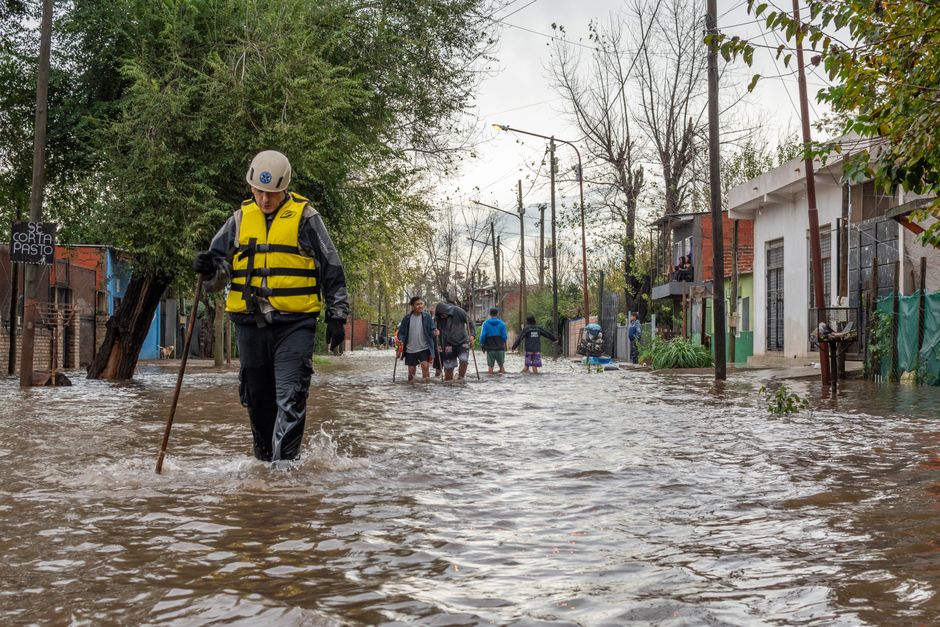
Hawaii is currently experiencing its worst flooding in over 20 years, leading officials to urge residents in severely affected areas to "LEAVE NOW." The warning was issued early Saturday after heavy rains compounded the effects of a winter storm a week prior, saturating the soil and creating a heightened risk of flooding.More rain is expected throughout the weekend, exacerbating the situation further.
Sources:
nbcnews.comnbclosangeles.comFloodwaters have inundated vast regions of Oahu's North Shore, a renowned surfing destination, lifting homes and vehicles and prompting evacuation orders for about 5,500 residents north of Honolulu.Authorities are particularly concerned about the risk of failure of the 120-year-old Wahiawa dam, which has been deemed "at risk of imminent failure." The National Weather Service has issued flash flood warnings as conditions continue to deteriorate.
Sources:
latimes.comwhdh.comGovernor Josh Green has indicated that the financial impact of the storm could exceed $1 billion, with damage extending to airports, schools, roads, homes, and even a hospital in Maui."This is going to have a very serious consequence for us as a state," he stated during a news conference.Most areas of the state are under a flood watch, especially Haleiwa and Waialua, which face immediate threats from rising waters.
Source:
yahoo.comFortunately, no fatalities have been reported, and over 200 individuals have been rescued from floodwaters.However, approximately 10 people have required hospitalization due to hypothermia, according to officials.Crews have been conducting search and rescue operations both by air and water, despite challenges posed by personal drones flown by onlookers attempting to capture images of the flooding.
Sources:
nbclosangeles.comwhdh.comThe current flooding crisis is the most severe since 2004, when extensive flooding affected homes and infrastructure in Manoa.The National Weather Service reported that parts of Oahu received between 8 and 12 inches of rain overnight, while the island's highest peak, Kaala, recorded nearly 16 inches within the same timeframe.
Sources:
nbcnews.comlatimes.comAuthorities have attributed the flooding to winter storm systems known as "Kona lows," which bring moisture-laden air into the region.These systems have been responsible for the recent deluges, and experts warn that the frequency and intensity of heavy rainfall in Hawaii are increasing due to climate change.
Sources:
nbclosangeles.comyahoo.comThe situation at the Wahiawa dam remains critical.Water levels in the dam, located approximately 17 miles northwest of Honolulu, have fluctuated, peaking at over 85 feet before receding slightly.However, these levels are still perilously close to the dam's threshold, which raises concerns about its integrity under the current conditions.
Source:
whdh.comResidents like Kathleen Pahinui, who evacuated due to the dam's threat, expressed deep concern about the aging infrastructure."Just pray for us," she remarked, aware that more rain is forecasted.The state has classified the Wahiawa dam as having "high hazard potential," indicating that its failure could lead to significant loss of life.
Sources:
latimes.comyahoo.comThe dam, originally constructed in 1906 to support agricultural production, has faced scrutiny for years.The state has issued multiple notices of deficiency to Dole Food Company, which owns the dam.Despite proposals for its donation to the state for necessary repairs, the transfer has yet to be finalized.
Sources:
whdh.comyahoo.comAs authorities monitor the situation, they are also preparing for potential further evacuations and damage assessments.Local residents are urged to remain vigilant, as conditions can change rapidly with the ongoing rainfall."We're seeing the waters receding in many places, but even a small amount of rain can lead to renewed flooding," warned Molly Pierce, spokesperson for Oahu's Department of Emergency Management.
Source:
nbclosangeles.comThe repercussions of this flooding event will likely be felt across the state for years to come, with the immediate priority being the safety of residents and the stabilization of critical infrastructure.